Showing posts with label moon. Show all posts

Thursday, April 25, 2013

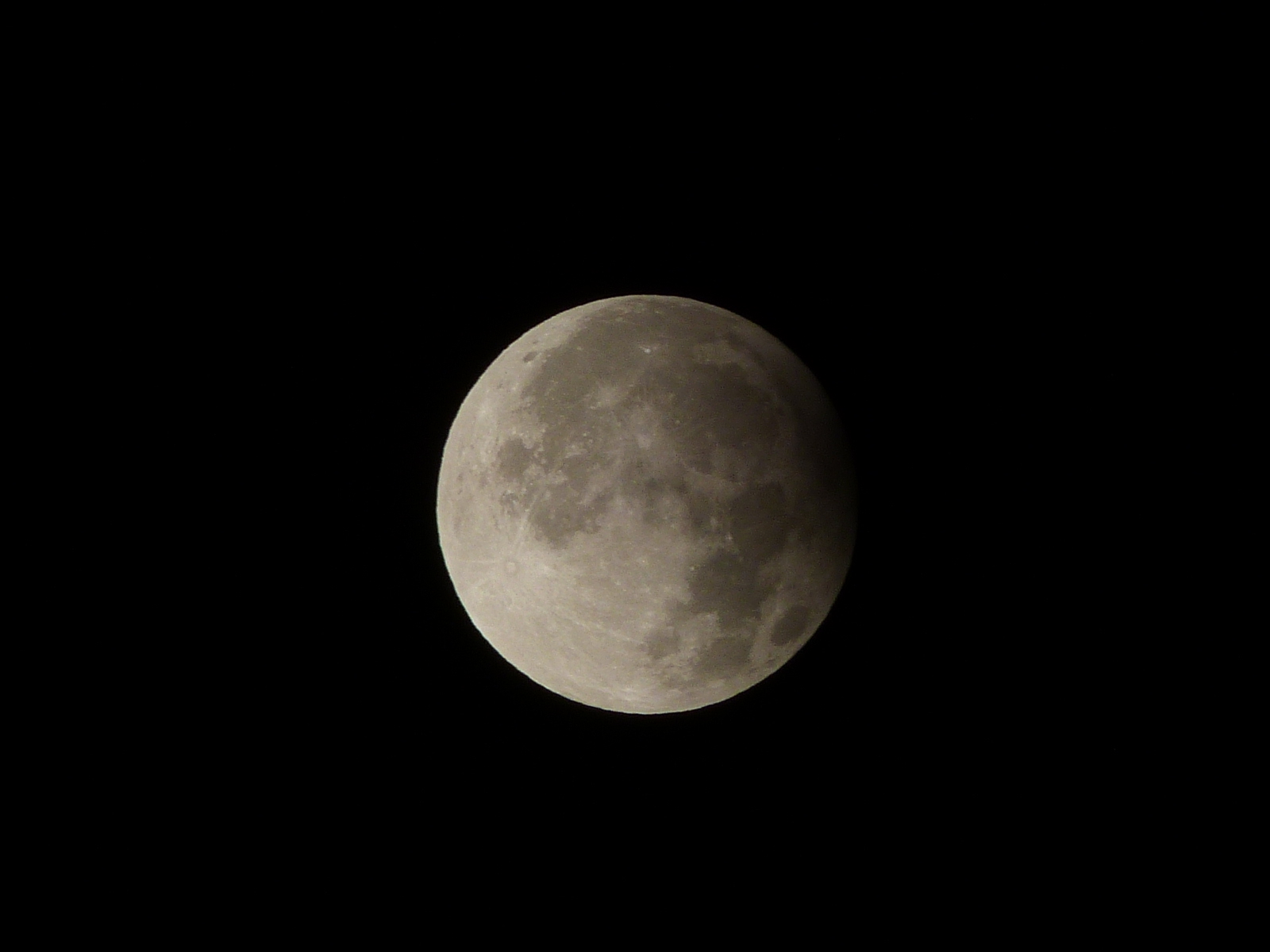
Partial Lunar Eclipse Seen from Gensan

I realized that only a few people are interested in celestial events, such as the recent partial lunar eclipse. Anyway, it wasn't that spectacular. Worse, it had to occur in the small hours of Friday, April 26, 2013. Charts indicated that the eclipse started around 2:03 a.m. Philippine Time, but I set my alarm for 3 a.m., around which time I would see the penumbral shadow of the Earth on the moon.


As the moon passes by the penumbral shadow of the Earth, its brightness decreases a bit, but untrained eyes won't be able to discern any difference. However, cameras can. Anyway, this part of the eclipse isn't so spectacular. Recalling the penumbral lunar eclipse on November 28, 2012, I can say it wasn't thrilling. Check out the photos of the Nov.28, 2012 eclipse here: 11/28/2012 penumbral lunar eclipse


The moon touched the umbral (darker) shadow of the Earth at 3:54 a.m. That's according to charts. 


According to EarthSky.org, the peak of the eclipse is at 20:07 UTC or 4:07 a.m. Philippine Time. 


Then the moon started slipping away from the Earth's shadow.


I called it a night at 5 a.m. Nothing really too spectacular about partial lunar eclipses, but I'm a bit glad to have recorded this celestial event.


Thursday, March 14, 2013

Crescent Moon Seen from Gensan


I have yet to see or photograph a young moon, so for now I'll just have to enjoy looking at slim waxing crescent moons. Early waxing crescent moons are tough to photograph because they're not as bright as gibbous moons. Focusing is also a little tricky. Sometimes I manage to get decent handheld shots. I only use the tripod when I want to expose the earthshine. It's a good thing our house faces the west. Hence, it's easy to go outside to catch the crescent moon.

2/12/2013 6:24pm

2/12/2013 6:31pm

2/13/2013 6:07pm

2/14/2013 6:13pm

Sunday, March 10, 2013

Capturing the Moon's Earthshine

What I love about crescent moons is the so called earthshine, which is a faintly visible illumination of the dark side of the moon. It's called earthshine because it's the Earth's reflected light cast on the night side of the moon. In the past three days, I observed the waxing crescent moon and took photos of it.


waxing crescent moon 2/12/2013 6:32pm 


waxing crescent moon with earthshine 2/14.2013 6:39pm


Friday, December 28, 2012

Last Full Moon of 2012


There's really nothing special about the moon tonight. In fact, it looks like any other full moon. However, for "lunatics" and night sky observers out there, it's a special full moon as it's the last one for the year 2012. I waited for the moon to rise. Good thing the sky was clear. I also captured long exposure shots of the eastern sky.


Monday, December 24, 2012

Christmas Eve Halo

If anyone looked at the sky on Christmas Eve, they would have seen a beautiful gibbous moon and the shining Jupiter nearby. Here in General Santos City, the sky was veiled by some cloud cover. I did, however, get lucky when I got the chance to photograph the halo. This was when everyone was helping themselves to the Christmas buffet.

If my memory serves me right, a halo forms when the moon (or sun) shines through a layer of cirrostratus clouds. Last night, the appearance of the halo with the Jupiter in it thrilled me. Here's the photo.


How was your Christmas Eve?

Sunday, December 2, 2012

How to Photograph the Moon with a Superzoom Camera?


Superzoom point-and-shoot cameras are slowly gaining popularity over the years. They are cameras that look like DSLRs but are truly point-and-shoots at heart. They have DSLR-like functions yet have a basic 1/2.3” sensor. What makes them awesome is their long-zoom lenses that go above 20X. They have versatile capabilities that allow you to shoot wide landscapes and get close-up snapshots of birds.

Many enthusiasts use long-zoom P&S cameras to take photos of the moon. I own a Panasonic FZ47, a humble megazoom camera, which is the cheapest in its category. If you have other bridge camera, you can use it to photograph the moon.

Look at the phase of the moon. How you set your camera depends on the phase of the moon. A crescent moon is difficult to photograph without a tripod. A full moon, on the other hand, can be photographed handheld. I suggest shooting in manual mode. Zoom in your camera above 300 mm or above 10X, unless you want your moon to appear like a tiny disc in your photo.

A crescent moon 2-3 days before or after new moon can be photographed at slow shutter speeds of 1/4-1/10 seconds. You can use ISO 400-800, whichever allows you to come up with a properly exposed photo without the obvious noise. Small sensors are susceptible to image noise. You can use longer exposures (and possibly lower ISO) to expose the earthshine, the dark part of the moon subtly lit by earth’s reflected light.

4s ISO 100

1/4s ISO 400

As the illuminated side of the moon gets progressively larger in the succeeding nights, you can use faster shutter speeds, say 1/30-1/50 seconds at ISO 200-400.

1/50s ISO 400

The first quarter and last quarter moon has enough light to allow you to use shutter speeds faster than 1/60s at ISO 100-200. If you’re shooting handheld, make sure to hold your hands steady and shoot several photos so that at least one or two of them come out sharp. This is your opportunity to capture the craters on the moon nicely.
Last Quarter (1/80s ISO 400)

The gibbous phases and the full moon are easy to photograph because of their natural brightness. You wouldn’t need a tripod. You can shoot at low ISO (100-200) and fast shutter speeds (1/100s-1/800s). You can even go to Program mode and use Spot metering, which automatically exposes the bright disc of the moon quite well.
1/400s ISO 400

1/250s ISO 160


1/200s ISO 100


Should you go past the optical zoom? The Panasonic FZ47 only has 24X zoom, equivalent to 600mm on a 35mm DSLR. A full moon image taken at 600-mm looks like a small disc. If you want a larger moon image, you can go past the optical zoom and continue to zoom in until the moon covers a huge part of the LCD screen. Many point-and-shoot cameras have intelligent zoom feature that allow you to go farther than the optical zoom limit at lower resolution. Another way to make the moon bigger in your photos is through cropping. Set your camera’s resolution to 10 or 12 MP. Then crop your photos. Make sure to check the cropped photos if they look decent enough. Cropping can make image noise and artifacts to become more obvious. 

12 MP Image

cropped version of the same photo


Sunday, September 16, 2012

Becoming a Snapshooter


I never thought I would love to have cameras. Photography wasn’t something I wished to learn, but here I am writing this post.

My interest in shapshooting started when my ex-boss from Davao City spent her birthday here in GenSan. She and her family spent two days here. Together with a friend, I toured them to Sarangani Highlands, Plaza Heneral Santos, and Queen Tuna Park. We didn’t have much time to visit other places. Anyway, they had their cameras with them, and they took a lot of photos. I figured out that if I had a camera with me, I would have taken photos too and have my own photographic mementos too.


So, I decided it was time to own a camera. I didn’t know about cameras back then. My budget was only fit for a cheap gadget. My first choice was Samsung ES65, a cheap point-and-shoot thingy that I used for four short months. It was quickly replaced by another cheap model, a Canon PowerShot A495. Both cameras were classed in the budget category, but the latter took better photos. My father uses Samsung ES65 now.

I learned about taking snapshots with the Canon A495, a humble gear that runs on AA batteries. It’s the cheapest camera then, available at local stores for about Php 3,500. You really couldn’t complain if you’re just after a device that lets you take snaps. It became my companion for over a year. 

Point-and-shoot cameras are pretty easy to use. If you own a compact model, you probably like the fact that it’s really a point-and-shoot thing. There is no thinking about the settings. Many people who use cheap cameras just point them at their subject and press the shutter button, nothing complicated.

I learned to take pictures with my humble little guy. Most of my photos were random shots I took whenever I wanted to take a break from work. I would take snaps of my cute, little niece. My photos were mostly flowers, places, and small insects. The snapshots fill my Facebook account. I seldom post photos on Flickr. I did have a Blogger account where I used to upload photos, but it was compromised.

While Samsung ES65 was a downright terrible camera, Canon A495, on the other hand, had its share of downsides. One thing I used to complain about it is its sluggishness. It takes a while to get a shot. It’s okay if you’re taking shots of still subjects, but not if you’re taking shots of moving kids or animals. I had two pairs of rechargeable batteries for that little gear, but months of daily snapshooting exhausted both pairs. Soon, I will have to buy another pair, although I seldom use the cheap guy now.


If there were two things that the humble Canon camera taught me, those were pre-focusing and composing. It made me learn about things like ISO or white balance. I love doing macro shots with that camera. Some of my best close-up shots were taken with that camera.

However, the limitations were already overwhelming, and I was itching to buy another buddy, this time one that had a long zoom. The reason I wanted to own a long zoom camera is to be able take photos of the moon. It sounds silly, but that was really the reason. I get envious when I see photos of the moon on the internet.

So, I bought my third camera, a Panasonic FZ47, a superzoom camera with 24X optical zoom. A superzoom camera is what they call a camera with more than 10X optical zoom. Superzooms are becoming popular in the market of snapshooters and enthusiasts. They are also chosen by a number of travelers. Essentially, they are P&S cameras with long zooms. They are made of sensors whose size is similar to those of small compacts. Superzooms look like DSLR camera, but the image quality isn’t the same.


Anyway, having moved from a small compact Canon to a bulky long-zoom Panasonic, I was thrilled at the versatility of my new gadget. Also, it gave more controls, which made shooting in difficult situations a little more manageable. In four months, I was able to take thousand of photos, including those of the moon, birds, people, and places. I became an enthusiast, someone who would often spend weekends going outdoors to take photos of anything. With Panasonic FZ47, I learned to make finer adjustments of the aperture and shutter speed. I also learned how to shoot in the manual mode, something I thought I would never learn.
The Host during Mr. and Ms. GenSan Pageant 2012
I may never upgrade to a DSLR gear. The FZ47 is already too bulky for me that sometimes I feel like leaving it at home. DSLRs are bulkier than superzooms. I don’t think the superior image quality is worth all the weight, cost, and hassle. But who knows, I might get tired at the noisy images produced by my current snapshooting companion and find myself holding a bulky thingy.